
Key takeaways
- Capacity: 180 lbs total, as stated in the product name
- Seating: 2 seater, wagon configuration
- Brand: HARPPA
- Price tier: Premium
- Frame class: wagon chassis, not a lightweight umbrella frame
The best strollers for big kids prioritize load-rated frames and wide, deep seats over the compact folds that define mainstream baby strollers. If you need one pick, the Harppa Remy Wagon Stroller for 2 Kids (180 lbs capacity) is the strongest all-around answer for most families: two full seats, a 180-pound total capacity, and a wagon layout that keeps older riders comfortable well past the preschool years. The BabyVista Stroller Wagon is the value alternative for parents who want a one-hand adjustable push/pull handle without a premium price, while the Harppa Remy XL (280 lbs, 4 seats) is the choice for larger families hauling multiple big kids at once. Below, weight limits, seat width, wheel durability, fold size, and storage trade-offs are broken down product by product so you can match a stroller to a specific child, not just a category.
Top 3 Picks
Best overall: Harppa Remy Wagon Stroller for 2 Kids. A 180-pound capacity across two seats gives you genuine headroom for a 60-to-80-pound rider plus a sibling, and the wagon format solves the legroom problem that dooms most single-seat strollers for older children. It suits families with two kids roughly five and under who still want one pushable unit.
Best budget: Cool Kids Superb Lightweight Travel Stroller. An auto-fold buggy in a rose gold finish that trades seat width and peak load for a genuinely light, fast-folding travel package. Best for a lighter four-to-six-year-old who mostly walks and only rides in bursts.
Best premium / multi-kid: Harppa Remy XL Wagon Stroller for 4 Kids. A 280-pound capacity across four seats turns the wagon into a small people-mover. It is the only pick here designed for three or more riders at once, and the right answer when “big kids” means a whole crew.
Quick Comparison
| Product | Best for | Key specs | Price tier |
|---|---|---|---|
| Harppa Remy Wagon Stroller for 2 Kids | Two big kids, one pushable unit | 180 lbs capacity; 2 seater; wagon frame | Premium |
| BabyVista Stroller Wagon for Kids | Value wagon with one-hand handle | Wagon layout; one-hand adjustable push/pull handle; multi-kid seating | Mid-range |
| Harppa Remy XL Wagon Stroller for 4 Kids | Large families, 3+ riders | 280 lbs capacity; 4 seater; wagon frame | Premium |
| Cool Kids Superb Lightweight Travel Stroller | Light travel, occasional rider | Lightweight travel buggy; auto fold; rose gold finish | Budget |
| Generic Lightweight Umbrella Stroller (Ages 1–6) | Cheapest secondary/backup stroller | Umbrella fold; marketed for ages 1–6; lightweight | Budget |
| ELEMARA Foldable Wagon Stroller | All-terrain two-kid hauling | All-terrain wagon; 2-kid seating; removable component; foldable frame | Mid-range |
| Baby Doll Compact Travel Stroller (The New York Doll Collection) | Doll/toy stroller for pretend play | 31″ lightweight; folding; with canopy | Budget |
Note the range, not just the ranks: budget picks here sit at the low end of the market, mid-range wagons cluster in the middle, and the two Harppa Remy models sit at the top. Prices fluctuate seasonally, so treat the tiers as relative positions rather than fixed numbers.
How We Chose
Selection started from the load rating, because that single number decides whether a stroller is usable at all for a heavy child. Anything marketed to ages one through six with no stated capacity was treated as a light-duty product and grouped with the budget picks rather than the big-kid wagons. From there, we filtered by category fit: wagons were evaluated as multi-rider platforms, travel strollers as single-rider portability plays, and the doll stroller as a toy rather than a child transport.
Use case drove the second cut. A family with one light rider and a car trunk to fill needs a completely different product than a family with three riders and a garage. We weighted seat count, seating layout, and handle design — especially push/pull convertible handles, which matter for older children because a big kid’s weight shifts the center of gravity backward and makes a standard push-only bar awkward.
Finally, we considered upgrade path. A cheap umbrella stroller is often a second stroller, not a first; a wagon is often a replacement for a stroller that a child outgrew. This article draws on manufacturer specifications and published listing details — no products were physically tested or owned, and no performance claims are made beyond what the stated specs support.
1. Harppa Remy Wagon Stroller for 2 Kids – Best for Two Big Kids in One Pushable Unit
As an Amazon Associate we earn from qualifying purchases at no extra cost to you.

This is the pick for the family whose problem is not “my child is too heavy for a stroller” but “my child is too heavy for two separate strollers.” The Harppa Remy Wagon Stroller for 2 Kids pairs a 180-pound total capacity with a two-seat wagon layout, which means the weight of both riders is carried by one frame, one set of wheels, and one adult. For parents who have been juggling a hand-me-down single stroller plus a scooter plus a backpack, that consolidation is the whole value proposition.
Who it suits
Families with two riders who have outgrown standard strollers but are not ready to walk long distances — think a five-year-old and a three-year-old, or a heavier four-year-old plus a toddler. It also suits caregivers who do a lot of single-adult outings, because managing two children with two hands free enough to push one wagon is easier than managing two children and two strollers.
Key specs
- Capacity: 180 lbs total, as stated in the product name
- Seating: 2 seater, wagon configuration
- Brand: HARPPA
- Price tier: Premium
- Frame class: wagon chassis, not a lightweight umbrella frame
Why the 180-pound figure matters
Weight capacity is the number that quietly retires most strollers. A typical lightweight stroller is engineered around a 40-to-50-pound child, and older kids hit that ceiling around age four or five. Once a child is at or near the limit, the frame flexes, the front wheels shimmy, and the fold mechanism starts binding — the stroller does not fail dramatically, it just becomes unpleasant to push. A 180-pound total capacity split across two children gives you roughly 90 pounds per rider as a theoretical ceiling, which comfortably covers most eight-year-olds even if they are heavy for their age.
The practical benefit is margin. Running a frame at 50 percent of its rated load means the joints, folding latches, and wheel bearings live longer than they would at 90 percent, and the stroller still feels solid when one child shifts their weight suddenly — which is the moment cheap strollers announce themselves.
Strengths
- One frame replaces two strollers, reducing total gear volume in a car or hallway
- 180 lbs of headroom means both riders can grow into it rather than out of it
- Two-seat layout keeps siblings physically together, which simplifies supervision
- Premium construction tier suggests reinforced joints and a heavier-duty axle than budget wagons
Pros
- High total capacity for the two-rider format
- Consolidates two children into a single push
- Wagon seating gives older kids foot room a bucket seat denies them
- Premium tier generally means serviceable, replaceable wheels rather than sealed throwaways
Cons
- Wagon footprint is larger than a stroller footprint, so tight store aisles and narrow doorways get awkward
- Heavier and bulkier to fold and lift than any travel stroller
- Premium price tier puts it well above budget umbrella options
- Overkill if you only ever transport one child
How it compares with the nearest alternative
Against the Harppa Remy XL, the standard Remy is the smaller sibling: two seats and 180 lbs versus four seats and 280 lbs. If your family is capped at two riders, the standard Remy is the smarter buy — you avoid paying for and maneuvering capacity you will never use. Against the BabyVista Stroller Wagon, the Remy costs more but offers a higher stated capacity and a more premium build tier; the BabyVista is the better choice if you want the wagon format and the one-hand adjustable push/pull handle at a mid-range price. Against the ELEMARA Foldable Wagon Stroller, the Remy is again the premium two-seater, while the ELEMARA competes on all-terrain capability and a removable component at mid-range pricing.
2. BabyVista Stroller Wagon – Best Mid-Range Wagon with a One-Hand Handle
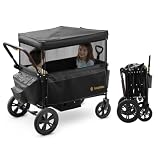
The BabyVista Stroller Wagon’s headline feature is in its name: a one-hand adjustable push/pull handle. That sounds like a minor convenience until you have pushed a loaded wagon with a two-handed bar while a child tries to climb in — the ability to reposition the handle with one hand, at any point on the route, is a genuine daily quality-of-life feature. Combine that with a wagon layout for kids and a mid-range price tier, and this is the pick that gets most of the premium wagon experience for less.
Who it suits
Parents who want the multi-kid wagon format but are priced out of the premium tier, and specifically parents who walk mixed routes — sidewalks, park paths, parking lots — where handle height and angle need to change between pushing and pulling. It is also a good fit for grandparents or secondary caregivers, because the one-hand adjustment reduces the learning curve on a new piece of gear.
Key specs
- Configuration: stroller wagon for kids, multi-rider seating
- Handle: one-hand adjustable push/pull design
- Brand: BabyVista
- Price tier: Mid-range
- Frame class: wagon chassis with convertible handle
Why a push/pull handle changes the physics
When you push any stroller or wagon, you are applying force above the load. With a heavy older child sitting high, that creates a leverage problem: the more weight in the seat, the more the front end wants to lift or wander, and the harder the adult has to grip. Pulling reverses the geometry — you are now leading the load rather than shoving it, which transfers effort through the handle and the frame more directly and tends to feel more stable at walking pace with a heavier rider.
A one-hand adjustable handle means you can switch between push and pull without stopping, and set the bar to your own height rather than a compromise between two adults. For anyone under about 5’4″ or over about 6’0″, that adjustability is more than a comfort feature; it determines whether the wagon tracks straight or fights you all afternoon.
Strengths
- Wagon seating format accommodates riders who have outgrown bucket seats
- One-hand handle adjustment suits mixed-height caregivers and mixed push/pull routes
- Mid-range pricing keeps it accessible while retaining the wagon feature set
- Stroller-wagon hybrid designation means it can serve as a primary stroller rather than a niche extra
Pros
- Handle adjustment is a real ergonomic win on long walks
- Multi-kid wagon format at a mid-range tier
- Push/pull convertibility helps with heavier riders
- Easier to justify than premium wagons for families with two moderate-weight kids
Cons
- No stated capacity in the same league as the Harppa Remy wagons, so very heavy riders may exceed comfortable limits
- Mid-range materials and hardware will not match premium build quality over years of use
- Wagon footprint still larger than a conventional stroller
- Fewer seats than the four-seat Harppa Remy XL
How it compares with the nearest alternative
Against the Harppa Remy Wagon Stroller for 2 Kids, the BabyVista gives up some capacity and premium build in exchange for a lower price and the one-hand adjustable handle design. Against the ELEMARA Foldable Wagon Stroller, both are mid-range two-kid wagons, but they compete on different axes: BabyVista leans on handle ergonomics, ELEMARA on all-terrain capability and a removable component. If your routes are mostly paved and your priority is adjustability, BabyVista; if you regularly cross grass, gravel, or park trails, ELEMARA. Against the premium Harppa Remy XL, the BabyVista is the sensible pick for two riders and the wrong pick for four.
3. Harppa Remy XL Wagon Stroller for 4 Kids – Best for Large Families and Multiple Riders

The Harppa Remy XL is the capacity champion of this list: 280 pounds across four seats. That combination — the highest stated total load here and the most seating positions — makes it the only pick that solves the “three or more kids at once” problem without strapping a second stroller together. If you have ever calculated that your family needs 1.5 strollers, this is the product that answers that math.
Who it suits
Families with three or four riders, daycares and childminders who transport small groups, and anyone who regularly hosts cousins, neighbors, or friends’ kids on outings. It also suits the family that wants one piece of gear to cover a five-year age spread — a toddler and three school-age kids can share the same wagon.
Key specs
- Capacity: 280 lbs total, as stated in the product name
- Seating: 4 seater, wagon configuration
- Brand: HARPPA
- Price tier: Premium
- Frame class: extended wagon chassis
What 280 pounds across four seats actually buys you
Four seats at 280 pounds works out to an average of 70 pounds per rider if all four seats are occupied — which is a useful number, because it tells you this wagon is designed for a mixed-age group rather than four eight-year-olds. In practice, that is exactly how large families use wagons: one or two heavier children plus two lighter ones. The math gives you about 280 pounds to distribute however you like, so a 100-pound child plus three 60-pound children fits comfortably, while four children averaging 85 pounds does not.
The other advantage of a four-seat frame is that it does not need to be full to be useful. Two heavy kids can spread out, use the outer positions, and avoid the shoulder-to-shoulder crowding that makes a two-seater tight for older riders. Empty seats also double as cargo space — a genuine bonus on grocery runs or park days when you are carrying blankets, bags, and a cooler.
Strengths
- Highest stated capacity in this roundup at 280 lbs
- Four seats cover a wide age range simultaneously
- Empty seats convert to cargo capacity
- Premium HARPPA build tier consistent with the smaller Remy model
Pros
- Solves group transport that no two-seater can
- Generous per-rider weight allowance for mixed-age groups
- Doubles as a gear hauler when not fully occupied
- One push for four children, which is less total effort than multiple strollers
Cons
- The largest footprint here — storage, doorways, and trunk space all become planning problems
- Heaviest fold and lift in the roundup
- Premium price tier, and four seats is more capacity than most families need
- Overkill and cumbersome for a single rider
How it compares with the nearest alternative
Against the two-seat Harppa Remy Wagon Stroller, the XL is a straight capacity upgrade: same brand, same wagon concept, double the seats, 100 more pounds of rated load. Choose the XL only if you genuinely have three or more riders; the standard Remy is easier to live with otherwise. Against the BabyVista Stroller Wagon, the XL is the premium, higher-capacity option and the BabyVista is the mid-range, more maneuverable one. Against the ELEMARA Foldable Wagon Stroller, the ELEMARA is a two-kid all-terrain wagon, so it competes on terrain rather than seat count — if you need four seats, the ELEMARA is not in the conversation.
4. Cool Kids Superb Lightweight Travel Stroller – Best Budget Travel Stroller for Occasional Riders

The Cool Kids Superb is the opposite philosophy to a wagon: light, fast-folding, and built for short bursts of riding rather than all-day hauling. Its auto fold mechanism and rose gold finish make it a stroller you can deploy one-handed in a parking lot and stow in a small trunk, which is exactly what a family with a light four-to-six-year-old actually needs on errand days.
Who it suits
Parents of children who mostly walk but still need a ride mid-outing — the classic “I’m tired” two-thirds of the way through a museum trip. It suits city families, transit users, and anyone whose storage is a closet rather than a garage. It also works as a secondary stroller for travel when the primary wagon stays home.
Key specs
- Type: lightweight travel stroller / auto fold buggy
- Fold: automatic folding mechanism
- Finish: rose gold
- Brand: COOL KIDS
- Price tier: Budget
Where a travel stroller wins and loses
Travel strollers optimize for two things: weight and folded volume. Every design decision that reduces those — thinner tubing, smaller wheels, a narrower seat, a lighter folding mechanism — works directly against the qualities that make a stroller good for a big kid. So the trade-off is explicit: you are buying portability and paying for it in capacity and seat width.
That is a fair trade for the right rider. A 40-to-50-pound six-year-old who rides ten minutes at a time does not need a 180-pound frame; they need a stroller that is already folded and light when you need it. The auto fold is the key feature here, because the real failure mode of travel strollers is the parent refusing to bring them — a stroller that takes thirty seconds to fold and a two-handed lift to stow gets left at home. An auto fold removes that friction.
Strengths
- Auto fold makes deployment and stowage genuinely quick
- Lightweight construction eases lifting into trunks and overhead bins
- Budget price tier makes it an easy second stroller or a first stroller for a light child
- Distinctive rose gold finish means it is easy to spot in a stroller parking area
Pros
- Fast folding and light weight for travel and transit
- Low price tier lowers the cost of trying the travel-stroller format
- Compact enough for tight storage
- Fast to deploy one-handed while holding a child’s hand
Cons
- Not rated for the loads a wagon handles — unsuitable as a primary stroller for a heavy older child
- Smaller wheels struggle on gravel, grass, and uneven pavement
- Narrower seat and less legroom than a wagon
- Lightweight frames generally show wear sooner under frequent heavy use
How it compares with the nearest alternative
Against the Generic Lightweight Umbrella Stroller (Ages 1–6), the Cool Kids Superb is the better-engineered travel stroller: the auto fold is a meaningful upgrade over a manual umbrella fold, and the build is more purpose-built for travel. Against the Baby Doll Compact Travel Stroller, they are entirely different products — the Cool Kids is a real child stroller, the doll stroller is a toy — so the comparison only matters if you are shopping for a gift and briefly confused the two categories. Against a wagon like the BabyVista, the trade is obvious: the Cool Kids wins on weight and fold size, and loses on capacity, seat width, and rider comfort.
5. Generic Lightweight Umbrella Stroller (Ages 1–6) – Best Budget Backup Stroller

The Generic Lightweight Umbrella Stroller is exactly what its name says: a simple, inexpensive umbrella-fold stroller marketed for ages one through six. It is not a big-kid stroller in the capacity sense — it is a big-kid stroller in the “light enough to be the stroller you keep in the car and forget about” sense. For families whose older child only occasionally needs a seat, the price tier makes it nearly disposable, which is its own kind of value.
Who it suits
Parents who need a second or third stroller for a specific location — one at grandma’s house, one in the trunk — rather than a primary ride. It suits a light four-to-six-year-old on short trips and any family where the primary stroller is a wagon that is too big to bring everywhere.
Key specs
- Type: lightweight umbrella stroller
- Marketed age range: 1–6 years
- Fold: umbrella-style compact fold
- Brand: Generic
- Price tier: Budget
What an umbrella stroller is actually for
Umbrella strollers exist because a stroller’s usefulness is capped by whether you bother to bring it. A ten-pound stroller that lives in the trunk gets used; a forty-pound wagon that lives in the garage does not. The umbrella format strips the product to a frame, a seat, four small wheels, and a fold — no adjustable handle, minimal storage, often no recline.
That is why the marketed age range of one to six is instructive rather than reassuring: it reflects a weight-class assumption of a typical child, not a load rating. If your six-year-old is at the heavier end for their age, this stroller will be at its practical limit, and you will feel it in the flex of the frame and the effort of pushing. It is honest to treat this as a light-duty product and choose it for the right rider rather than expecting wagon behavior.
Strengths
- Lowest barrier to entry of any stroller type — easy to justify as a spare
- Umbrella fold is compact and quick once you have done it a few times
- Light enough for older children to walk beside you rather than be carried
- Take-apart-simple design means fewer mechanisms to break
Pros
- Very low price tier
- Compact folded footprint for closet or trunk storage
- Simple construction with few failure points
- Good second stroller for a specific destination
Cons
- No stated high weight capacity — not a big-kid solution in the load sense
- Minimal or no storage basket and limited recline
- Small wheels are poor on rough ground
- Frame flex becomes noticeable as the rider approaches the practical upper limit
How it compares with the nearest alternative
Against the Cool Kids Superb Lightweight Travel Stroller, the Generic umbrella stroller is simpler and cheaper but gives up the auto fold and the travel-specific design. Against the Baby Doll Compact Travel Stroller, the two sit in the same low price tier but serve different jobs entirely — one transports a child, the other transports a doll. Against any wagon on this list, the Generic is a fraction of the weight and fold size and a fraction of the capacity; it is a complement to a wagon, not a replacement.
6. ELEMARA Foldable Wagon Stroller – Best All-Terrain Wagon for Two Kids

The ELEMARA Foldable Wagon Stroller takes the two-kid wagon format and points it at terrain. An all-terrain wagon with a removable component and a foldable frame, it is the pick for families whose stroller routes are not sidewalks — park trails, gravel paths, grass fields, festival grounds, and beach-adjacent boardwalks. Where lightweight travel strollers tap out, an all-terrain wagon keeps rolling.
Who it suits
Outdoor-oriented families: hikers, park regulars, sports parents, and anyone who walks on unpaved surfaces more than once a week. It also suits families who want one wagon that works in the neighborhood and on the trail, and who value a foldable frame for getting it into a car.
Key specs
- Type: foldable wagon stroller
- Seating: 2 kids
- Terrain: all-terrain wagon design
- Feature: removable component (per listing name)
- Brand: ELEMARA
- Price tier: Mid-range
Why wheel and tire design is the real spec sheet
Terrain capability is almost entirely about wheel diameter and tire width. Small hard wheels sink into soft ground and catch on gravel; larger, wider wheels roll over uneven surfaces by bridging small obstacles instead of hitting them. This is why all-terrain wagons are heavier and bulkier than their paved-path equivalents — the wheels themselves are the weight penalty, and it is a penalty worth paying if your routes are rough.
The removable component matters for a different reason: it is a serviceability feature. On a wagon that lives outdoors, the parts that wear are predictable — tires, wheel bearings, fabric, and any component that takes knocks during folding. A removed or replaceable component is a repair path rather than a replacement path, which is exactly what you want on a mid-range wagon you plan to use for several years.
Strengths
- All-terrain design extends usable routes well beyond pavement
- Two-kid wagon seating for riders who have outgrown bucket seats
- Mid-range pricing against a feature set that competes with premium wagons
- Foldable frame keeps it transportable despite the heavier wheels
Pros
- Handles grass, gravel, and uneven ground that defeat travel strollers
- Two-seat wagon layout suits siblings and friends
- Mid-range tier offers a strong price-to-capability ratio
- Removable component supports maintenance and longevity
Cons
- Only two seats — not a solution for three or more riders
- All-terrain wheels add weight and bulk to folding and lifting
- No stated capacity in the same range as the premium Harppa models
- Heavier than a travel stroller for purely urban errands
How it compares with the nearest alternative
Against the BabyVista Stroller Wagon, this is the closest head-to-head in the roundup: both are mid-range two-kid wagons. ELEMARA wins on terrain and on the removable component; BabyVista wins on handle ergonomics with its one-hand adjustable push/pull design. Buy ELEMARA if your routes are rough, BabyVista if your priority is adjustability on paved paths. Against the Harppa Remy Wagon Stroller, the ELEMARA is cheaper and more terrain-capable, while the Remy offers higher stated capacity and a premium tier. Against the Harppa Remy XL, the ELEMARA simply cannot compete on seat count.
7. Baby Doll Compact Travel Stroller (The New York Doll Collection) – Best Doll Stroller for Pretend Play

The Baby Doll Compact Travel Stroller is included here to draw a clear line: it is a doll stroller and a toy, not a child transport. The New York Doll Collection makes dolls and doll accessories, and this 31-inch lightweight folding doll stroller with a canopy is a companion piece for a reborn or baby doll. If you arrived searching for a stroller for a big kid and this appeared in your results, the correct answer is that this is not it.
Who it suits
Parents and gift-buyers shopping for a child who wants to push their doll the way a parent pushes a sibling — a classic parallel-play purchase. It suits the three-to-eight-year-old who is getting a doll or reborn doll and wants matching gear, and it works as a birthday or holiday gift where the recipient’s interest is dolls, not riding.
Key specs
- Type: folding doll stroller / toy
- Length: 31 inches
- Features: folding frame, canopy
- Intended use: reborn and baby doll transport (play)
- Brand: The New York Doll Collection
- Price tier: Budget
Why it belongs in a big-kid stroller article anyway
Two reasons. First, search results blur the categories — a compact travel stroller and a compact travel doll stroller read almost identically in a product title, and the confusion costs buyers a return. Second, an older child who has outgrown riding often redirects that interest into pushing something, and a doll stroller lets a six- or seven-year-old participate in the walk rather than being carried. That is a real developmental use case, just not a transport one.
Structurally, a doll stroller is built to a completely different standard: it is sized for a doll’s weight, not a child’s, so the frame, wheels, and fabric are all lighter-duty than even the cheapest child stroller. Treating it as a child stroller is the single most common mistake in this category.
Strengths
- Folds for storage, unusual at this size for doll strollers
- Canopy adds realism and shades the doll
- 31-inch length is proportionate for a child pushing it
- Low price tier makes it an easy add-on gift
Pros
- Encourages parallel play and walking rather than being carried
- Folding design stores flat in a closet or toy bin
- Matches a doll or reborn doll purchase
- Inexpensive enough to test whether the child is interested
Cons
- Not a child stroller — cannot and should not carry a child
- Light-duty frame and wheels unsuitable for rough ground or heavy use
- Only fits dolls, so usefulness ends when doll interest ends
- Easy to buy by mistake when searching for a compact travel stroller
How it compares with the nearest alternative
Against the Cool Kids Superb Lightweight Travel Stroller, the two share the compact-travel naming and nothing else: one carries a child, one carries a doll, and the doll stroller is sized and built accordingly. Against the Generic Lightweight Umbrella Stroller, the doll stroller is smaller and lighter still, but again has no child capacity. Against every wagon on this list, the comparison is meaningless by design — this is a toy category, and the only reason it appears here is to prevent a mis-purchase.
How to Choose
The core problem with shopping for big kids is that most of the product category was never designed for them. If you start from “stroller” you will end up browsing products engineered around a forty-pound toddler and then wonder why your five-year-old looks cramped. Start from three numbers instead: the rider’s weight, the number of riders, and the size of the folded package you can actually store.
Weight capacity: find the number, then add margin
The single most useful spec is the stated weight capacity, and it appears more often on wagons than on traditional strollers. A typical lightweight stroller is engineered around a 40-to-50-pound child — roughly a four- or five-year-old of average build. A wagon like the Harppa Remy states 180 pounds across two seats; the Remy XL states 280 pounds across four. Those numbers are total frame ratings, not per-seat ratings, so divide before you commit.
| Product | Stated capacity | Seats | Average lbs per seat if full |
|---|---|---|---|
| Harppa Remy Wagon Stroller for 2 Kids | 180 lbs | 2 | 90 lbs |
| Harppa Remy XL Wagon Stroller for 4 Kids | 280 lbs | 4 | 70 lbs |
| BabyVista Stroller Wagon | Not stated in listing name | Multi-kid wagon | — |
| ELEMARA Foldable Wagon Stroller | Not stated in listing name | 2 | — |
| Cool Kids Superb Lightweight Travel Stroller | Not stated in listing name | 1 | — |
| Generic Lightweight Umbrella Stroller | Not stated; marketed ages 1–6 | 1 | — |
That “average per seat if full” column is where most buyers make their first mistake. A four-seat wagon at 70 pounds per seat sounds enormous until you realize it means four eight-year-olds will overload it. The right reading is that the Remy XL is built for a mixed-age group — two heavier children plus two lighter ones — not a squad of big kids. If your group is uniformly heavy, you need more frames, not more seats.
The general rule: aim for a stated capacity at least 50 percent above the combined weight of your riders. Running at that margin preserves the fold mechanism, keeps the frame stiff, and means the stroller still works as a stroller after two years of use rather than as a device you have to drag.
Seat width and legroom: the spec that is never printed
Seat width is the least documented and most consequential dimension for older children. Manufacturers rarely publish it, which leaves two practical tests: the seating position and the footrest. A bucket-style seat with deep side walls and a five-point harness is designed to keep a toddler in place — for a six-year-old with long legs, it becomes a wedge. A flat bench or wagon seat, by contrast, lets the child sit upright with knees bent naturally and shift position on their own.
For a child over roughly 45 pounds, prioritize a flat or open seating surface, and check the distance from seat to footrest. If the child’s legs dangle without reaching the footrest, they will hook their feet under the seat or push against the front frame — both of which stress the stroller and make the ride miserable. Wagons are consistently better here because they started as cargo platforms and their interior volume was never optimized around a baby’s proportions.
Wheel and tire durability: what actually wears out first
The first components to fail on any stroller are, in rough order: the folding latch, the front wheel assembly, the fabric at high-stress seams, and the brake mechanism. Tires themselves rarely fail — they wear flat and lose tread, which matters more on all-terrain models where grip is the point.
| Component | Typical failure mode | What it means for ownership |
|---|---|---|
| Folding latch / joint | Wears with each fold; loosens and binds over years | Choose a simpler fold if you use it daily |
| Front wheel assembly | Bearing wear; shimmy under heavy front load | Larger wheels and a stiffer fork last longer |
| Fabric at stress seams | Fraying at harness anchors and seat corners | Darker, denser weaves clean better and hide wear |
| Brake mechanism | Housing corrosion; pedal stiffness | Rinse after wet or salted-road use |
| Tires (all-terrain) | Tread flattening; sidewall cracking from UV | Store out of direct sun between uses |
Two design choices reduce all of this wear. First, larger wheels with wider tires — they roll over obstacles instead of absorbing the impact. Second, fewer and more serviceable mechanisms: an auto fold is fast but adds a spring-loaded mechanism, while a plain umbrella fold has almost nothing to break. Choose according to whether you value speed or longevity.
Folding size and storage trade-offs
Folded size is where the wagon-versus-travel-stroller decision gets made, and it is almost always underestimated. A four-seat wagon folds into something closer to a small piece of furniture than a stroller — it will not fit a sedan trunk standing on end, and it will not fit an entryway closet without displacing something. A lightweight travel stroller folds small enough to stash in a footwell.
The practical question is not “which folds smaller” but “where will this live?” If the answer is “trunk, permanently,” a compact travel stroller earns its place. If the answer is “garage, and I wheel it out for park trips,” the fold size barely matters and you should spend the budget on capacity instead. Buying a wagon for a closet, or a travel stroller for a family of four riders, is the most common mismatch in this category.
Weight of the stroller itself
Capacity gets all the attention, but the stroller’s own weight determines whether you can get it into the car alone. All-terrain wagons are the heaviest because tires and a stiffer frame add mass; travel strollers are the lightest because everything has been pared down. If you regularly load the stroller solo — one hand on the frame, one on a child — a lighter stroller with lower capacity may serve you better in practice than a heavier wagon you dread lifting.
Handle design: push versus pull
Convertible push/pull handles, like the one-hand adjustable design on the BabyVista, are worth prioritizing once riders get heavy. Pulling a loaded wagon lets you lead the weight rather than push it, which reduces strain and improves stability. Adjustability matters too: if the handle is fixed at a single height, every caregiver who is significantly shorter or taller ends up leaning awkwardly, and that is a daily cost over years of use.
Terrain and wheel type
Match wheel design to your actual routes, honestly assessed. Paved neighborhood, sidewalks, mall, airport — a compact stroller’s small hard wheels are fine and lighter. Grass, gravel, packed dirt, park trails, festival grounds — you want the larger, wider wheels of an all-terrain wagon like the ELEMARA. Buying all-terrain wheels for a paved-only life means carrying weight you never use; buying compact wheels for weekly trail walks means fighting the stroller every trip.
Storage and accessories
Wagons generally offer more onboard storage because their interior volume is larger, and empty seats can be repurposed as cargo space. Traditional strollers vary widely — some have a substantial under-seat basket, some have almost none. If you routinely carry a diaper bag, groceries, or sports gear, treat storage as a real spec. On wagons, quantify it in seats left empty: two empty seats in a four-seater is genuinely useful cargo room, which is a quiet argument for buying slightly more wagon than you strictly need.
Budget tiers and what they buy
Budget strollers buy you a light, simple, low-commitment product and generally do not solve the big-kid problem in the load sense. Mid-range wagons buy terrain capability or handle ergonomics — often one or the other, rarely both. Premium wagons buy capacity, stiffer frames, and more robust hardware, and they hold up better under heavier riders. If your oldest rider is over about 50 pounds, spending up is not a luxury; it is the difference between a stroller that still functions in year three and one that has become a pushing exercise in frustration.
Frequently Asked Questions
What is the maximum weight a stroller can hold for a big kid?
Traditional strollers commonly rate around 40 to 50 pounds, which many children reach by age four or five. Wagon-format strollers go much higher: the Harppa Remy states 180 pounds total across two seats, and the Remy XL states 280 pounds across four. Check the total rating and then divide by the number of riders you plan to carry, because the total is a frame limit, not a per-seat limit.
At what age does a child outgrow a regular stroller?
Weight outgrows a stroller long before age does. An average child hits a 50-pound rating somewhere around age five or six, even though the marketed range often claims up to six or seven years. If your child is heavy for their age, the transition point arrives earlier — and the symptom is a frame that flexes and a stroller that suddenly feels hard to push rather than an outright failure.
Are wagon strollers better than regular strollers for older kids?
For most big kids, yes, primarily because of seating geometry. Wagons use a flat, open bench rather than a deep bucket seat, so longer legs bend naturally and children can shift position. Wagons also generally carry higher total weight ratings. The trade-off is footprint and fold size — a wagon is harder to store, harder to lift, and worse in narrow aisles than a compact stroller.
How wide should a stroller seat be for a six-year-old?
Seat width is rarely published, so judge it physically: a six-year-old should sit with hips fully supported and shoulders clear of the side walls, with knees bent rather than pressed up. If the child’s hips are squeezed or their shoulders rub the frame, the seat is too narrow regardless of the weight rating. Open wagon benches and flat seats usually pass this test better than bucket seats.
Do stroller wheels wear out, and which ones wear first?
Wheels themselves wear slowly; the parts around them fail sooner. Front wheel bearings are the most common early wear point because they take lateral loads, especially when the front end is heavy. Folding latches also loosen with repeated use. On all-terrain wagons, tire tread flattens and sidewalls can crack with prolonged UV exposure, so storing the stroller out of direct sun extends tire life noticeably.
Can a stroller wagon fit in a car trunk?
Two-seat wagons generally fold small enough for a mid-size or larger trunk, but four-seat wagons like the Harppa Remy XL are substantially bulkier and often need a folded-down rear seat or an SUV cargo area. If trunk fit is a hard requirement, measure your trunk’s height and depth before buying and prioritize the two-seat format or a compact travel stroller instead.
Is a lightweight travel stroller suitable for a heavy older child?
Generally no. Lightweight travel strollers are engineered around weight reduction, which means thinner tubing, smaller wheels, and a narrower seat — all of which work against carrying a heavy rider. They are best used for a lighter four-to-six-year-old who rides in short bursts. For a child over roughly 50 pounds, a wagon or a higher-rated stroller is the more honest choice.
How long should a stroller for big kids last?
With a rider well under the rated capacity, a quality wagon can reasonably serve several years and often through more than one child. The limiting factors are the folding mechanism, the front wheel assembly, and fabric at the harness anchors. Choosing a higher capacity than you need, rinsing the frame after wet or salted-road use, and storing it out of direct sun are the three habits that most extend service life.
Bottom Line by Situation
If you have two riders and want one stroller for both, the Harppa Remy Wagon Stroller for 2 Kids is the pick — 180 pounds of capacity in a two-seat wagon is the best balance of capability and daily usability here. If three or more children ride together, go straight to the Harppa Remy XL, because no two-seater solves that problem. If you want the wagon format and the one-hand adjustable handle on a mid-range budget, the BabyVista Stroller Wagon is the value answer. If your routes are rough — grass, gravel, trails — choose the ELEMARA Foldable Wagon Stroller and accept the extra weight as the price of all-terrain wheels. If your older child mostly walks and you need something light for travel and errands, the Cool Kids Superb Lightweight Travel Stroller is the budget travel pick, with the Generic Lightweight Umbrella Stroller as the even cheaper spare that lives in the trunk. And if you were looking for a compact travel stroller and landed on the Baby Doll Compact Travel Stroller, note that it is a toy for dolls — for an actual child, choose from the other six.


