Our Short List of 3
- Brand: PN Medical
- Training direction: Inspiratory and expiratory, independently adjustable
- Settings: 6 inspiratory settings and 5 expiratory settings
- Published healthy adult range: -140 cmH2O to +80 cmH2O

- Brand: POWERbreathe
- Model: PB2002, Plus Medium Resistance, Blue
- Training direction: Inspiratory only
- Resistance range: 23 to 186 cmH2O

- Brand: Expand-A-Lung
- Model: BD12512
- Training direction: Inspiratory and expiratory through one adjustable valve
- Resistance: Adjustable by rotating the end cap knob
All 4 Picks at a Glance
| Product | Specs | Action |
|---|---|---|
| 1. The Breather by PN Medical |
| Check price on Amazon |
| 2. POWERbreathe Plus Medium Resistance Inspiratory Muscle Trainer |
| Check price on Amazon |
| 3. Expand-A-Lung Breathing Fitness Exerciser |
| Check price on Amazon |
 5. Inhale Respiratory Trainer |
| Check price on Amazon |
Key takeaways
- Compare the best breathing trainers for runners, swimmers and singers, with adjustable resistance for inhale and exhale training in short daily sessions.
Breathing is a muscular job. Every breath in is driven mainly by the diaphragm and the muscles between the ribs, and every forceful breath out, the kind you use to finish a hill repeat, hold a long note, or recover between swim intervals, recruits the expiratory muscles as well. Breathing trainers are small handheld devices that add resistance to that job. You seal your lips around a mouthpiece and breathe through a narrowed opening, a dial-controlled valve, or a spring-loaded threshold valve, so the breathing muscles work harder for each breath.
The five devices below cover the main approaches. Some train only the breath in, where most muscular work happens at rest. Others train the breath in and out, which suits singers, wind players, and athletes who want a forceful exhale as well. Sessions take minutes, and progression means turning resistance up when the current setting feels manageable. This guide describes how each device works and what its maker publishes. It does not promise medical outcomes, and anyone with a heart, lung, or blood pressure condition should check with a clinician first.
Disclosure: As an Amazon Associate, I earn from qualifying purchases.
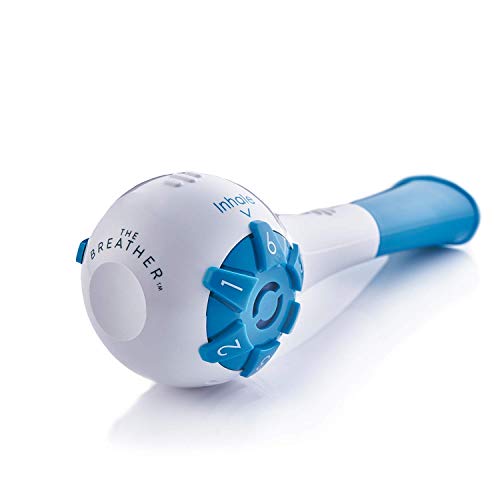
1. The Breather by PN Medical
- Brand: PN Medical
- Training direction: Inspiratory and expiratory, independently adjustable
- Settings: 6 inspiratory settings and 5 expiratory settings
- Published healthy adult range: -140 cmH2O to +80 cmH2O
The Breather is a combined inspiratory and expiratory trainer from PN Medical. Two independent dials sit on the body, one governing resistance as you breathe in and the other as you breathe out, so you can set a harder load for the direction that feels stronger and an easier load for the direction that needs work. PN Medical positions this original model for general users, everyday exercisers, and singers, with a guided mobile app and printed training journal available to pace sessions.
In practice, the separate dials are the reason to choose this model. A runner might keep the inhale dial moderate and the exhale dial low while learning the rhythm, then raise each independently over several weeks. Sessions follow the maker protocol of short sets of breaths, twice a day, six days a week, and cleaning is a warm soapy wash with the mouthpiece separated and left to dry fully. Because the load comes from dial-controlled openings, resistance also rises when you breathe faster, so slow, deliberate breaths give the most repeatable effect.
2. POWERbreathe Plus Medium Resistance Inspiratory Muscle Trainer
- Brand: POWERbreathe
- Model: PB2002, Plus Medium Resistance, Blue
- Training direction: Inspiratory only
- Resistance range: 23 to 186 cmH2O
The POWERbreathe Plus is a second-generation inspiratory muscle trainer built around a calibrated, spring-loaded pressure threshold valve. The valve stays closed until you breathe in hard enough to open it, so every breath in a set must reach the same set effort. That repeatability is why this style shows up so often in training studies. This Medium Resistance version, model PB2002 in blue, is the one POWERbreathe recommends for people who are already moderately fit to very fit.
Using it feels different from a dial trainer. There is no easy partial breath, because the valve either opens at the set threshold or it does not, so a set of thirty breaths is a clear, countable workout that takes only a few minutes. You turn the adjustment cap to move up through the settings as your inspiratory muscles adapt. It does not train the exhale, which is unloaded here, so pair it with other work if forceful exhaling matters for your sport or instrument. Follow the maker cleaning guidance, and keep the device for one person only.
3. Expand-A-Lung Breathing Fitness Exerciser
- Brand: Expand-A-Lung
- Model: BD12512
- Training direction: Inspiratory and expiratory through one adjustable valve
- Resistance: Adjustable by rotating the end cap knob
Expand-A-Lung takes the simplest route to the same idea. The device is a compact four-inch tube with a clear silicone mouthpiece at one end and a black adjustment cap at the other. Turning the knob on the cap narrows or widens the opening, changing how hard you work to move air in and out. There are no springs, electronics, apps, or numbered pressure scales, just a single control covering both directions. The company has made the device in the United States since the early 2000s for swimmers, runners, divers, and musicians.
The appeal is habit and portability. It slips into a gym bag, needs no setup, and a session can be two short sets of controlled breaths a day, raising the knob setting gradually when the current one feels easy. The trade-off is precision. With no published pressure range and no separate controls, you cannot match an inhale load to an exhale load or record an exact setting. Judge progress by knob position and by how the same setting feels week to week, and rinse the unit with dish soap, then let it drip dry with the mouthpiece facing down, as the maker directs.
4. Ultrabreathe Adjustable Resistance Lung Breathing Exerciser
The Ultrabreathe is a long-running British inspiratory trainer from Tangent Healthcare. It is a small handheld unit with a mouthpiece and an adjustable resistance mechanism that you turn to make breathing in progressively harder. It has been used as the training device in published respiratory muscle training work with voice students, which gives a sense of its audience: singers, speakers, and exercisers who want a simple inhale-focused routine without screens.
Specs
- Brand: Ultrabreathe
- Manufacturer: Tangent Healthcare Ltd
- Model number: S3529005
- Training direction: Inspiratory, with adjustable resistance
- Mechanism: Adjustable resistance dial
- Batteries: None required
- Format: Handheld, single mouthpiece design
- ASIN: B007CI0ZBC
In daily use, set a resistance you can manage with good form, breathe in for a short set, rest, and repeat, ideally seated until you know how loaded breathing feels. Because its resistance is not expressed as a published pressure scale comparable with POWERbreathe settings, progression is personal: note the setting that felt like hard but controlled work, and stay there until it no longer does. The compact body rinses easily and travels well.
5. Inhale Respiratory Trainer
- Brand: Inhale
- Training direction: Inspiratory and expiratory, bi-directional
- Resistance: Adjustable, single control for both directions
- Mouthpiece: Medical-grade silicone
The Inhale Respiratory Trainer is a compact, budget-minded option built around a soft medical-grade silicone mouthpiece and a single adjustable resistance control. It provides bi-directional resistance, so the same setting loads both the breath in and the breath out. The listing describes a design assembled in the USA and ships the trainer with a carrying case, which helps keep a device that lives in a gym bag clean between sessions. With no app or electronics, it suits people who want to try this training before committing to a calibrated model.
As an entry point, it does the important things right. The silicone mouthpiece is comfortable for short sessions, the case makes the habit easy to keep, and one control is as simple as progression gets. The limits follow from that simplicity. One control means the exhale cannot be set lighter than the inhale, and without published load figures its hardest setting cannot be meaningfully compared with the numbered settings on The Breather or POWERbreathe models.
How to Choose the Right Breathing Trainer
Begin with direction. If your goal is general endurance work for running, cycling, or swimming, an inspiratory-only trainer such as the POWERbreathe Plus or the Ultrabreathe matches where most of the muscular work happens, and a spring threshold valve gives the most repeatable load. If you sing, play a wind instrument, or want a strong, controlled exhale, choose a combined trainer. The Breather offers separate dials for each direction, while Expand-A-Lung and the Inhale trainer use one control for both, which is simpler but less precise.
Next, think about tracking. Numbered settings and published pressure ranges make it easy to record a session and step up in small increments, while unscaled knobs are judged by feel. Every device here works in short sessions, most makers suggest training most days, and all are single-user devices needing regular washing and complete drying. Finally, be honest about health context. Loaded breathing is exercise. Anyone recovering from chest, abdominal, ear, or eye surgery, or living with a lung, heart, or blood pressure condition should get a clinician view first, and everyone should stop and sit down if a session brings dizziness.
FAQ
How often should I use a breathing trainer?
Most makers here publish short daily routines, one or two sessions of a few minutes, on most days. The POWERbreathe protocol is thirty breaths twice a day, and PN Medical publishes sets of ten breaths. Consistency at a manageable setting matters more than occasional very hard sessions.
Should a beginner choose a light or medium resistance model?
Choose a model whose lowest settings you can complete with good form. New users do better with The Breather, Expand-A-Lung set low, or a light resistance spring model. The Medium Resistance POWERbreathe Plus is published for moderately fit to very fit users, so it is not the gentlest entry point.
Can I share a breathing trainer with a training partner?
No. These are single-user devices. A mouthpiece breathed through daily should not be shared, even within a household. Each person needs their own device, washed as the maker directs and stored fully dry in its pouch or case.
Do breathing trainers replace normal endurance training?
No. They train a small, specific muscle group in a few minutes away from your main sport. Runners, swimmers, and cyclists in published work used them alongside normal training, not instead of it. Think of a trainer as a focused accessory session, similar to a short core routine.
Used consistently, a breathing trainer is a simple accessory habit for an endurance athlete, swimmer, or singer. Pick the direction and control style that match your goal, begin at a setting you can handle with clean form, and progress slowly.
More from Amazon
Programs that pair well with the guide above. Offers and eligibility are set by Amazon and may change.
Free shipping on eligible items, Prime Video and more. Eligible new members can start with a free trial.
Start a Prime free trialA Prime membership for ages 18-24 with a trial period. Eligibility is set by Amazon.
See Prime for Young AdultsAudiobooks and podcasts to listen to on the go. Eligible new members can start with a free trial.
Try Audible freeAd-free music streaming. Eligible new subscribers can start with a free trial.
Try Music Unlimited freeAs an Amazon Associate we earn from qualifying purchases.