Key takeaways
- Compare the best melodicas from Yamaha, Hohner, Suzuki, Eastar and CAHAYA by key count, reeds, mouthpieces and cases to find the right fit for you.
A melodica sits somewhere between a keyboard and a wind instrument. You press piano-style keys with one hand while blowing air through a mouthpiece or a flexible tube, and metal reeds inside turn that breath into a bright, reedy tone that recalls both a harmonica and a small accordion. Yamaha calls its version the Pianica and Suzuki the Melodion, but the playing idea is the same across brands.
That is why melodicas show up in classrooms, folk and reggae bands, street performances, and home practice. There are no batteries or cables, and no setup beyond taking it out of its case. The real differences are key count, reed material, airtightness, and mouthpieces. A leaky, poorly tuned model can discourage a beginner, while a well-sealed instrument rewards steady breath control and clean fingering.
This guide compares five melodicas from five makers: a school-ready 32-key model, several 37-key options, and a higher-grade metal-cover instrument. Each pick lists verified specifications so you can match range, size, and accessories to how you plan to play.
Disclosure: As an Amazon Associate, I earn from qualifying purchases.
Yamaha P-37D Pianica

The Yamaha P-37D is the performer-leaning pick in this group. It offers a full three-octave range from F3 to F6 across 37 keys, which is enough room for most melodies, simple harmonies, and ensemble parts without running off the end of the keyboard. Yamaha builds the P-37D with a seamless rubber seal to guard against air leaks, and each key uses its own suspension spring with anti-vibration guides, so keys press and release smoothly during fast passages and quiet phrases alike.
Breath response is a strength here. The instrument projects a rich, full sound even with a small amount of air, which helps newer players learning breath control and helps experienced players shape dynamics. The mouthpiece is shaped to reduce mouth fatigue, and you can play directly on it or with the extension pipe attached, resting the instrument on a table and using both hands. Each instrument is also fine-tuned and adjusted by factory specialists before it ships.
Choose the P-37D in maroon if you want a 37-key melodica built for regular playing, and if even tone across the whole range matters more than the lightest possible body.
Specs
- Keys: 37 piano-style keys
- Range: F3 to F6, three full octaves
- Color: Maroon
- Seal: Seamless rubber seal against air leaks
- Key action: Individual suspension spring per key with anti-vibration guides
- Playing options: Mouthpiece alone or mouthpiece with extension pipe
- Tuning: Fine-tuned and adjusted at the factory
Hohner 32B Instructor Melodica
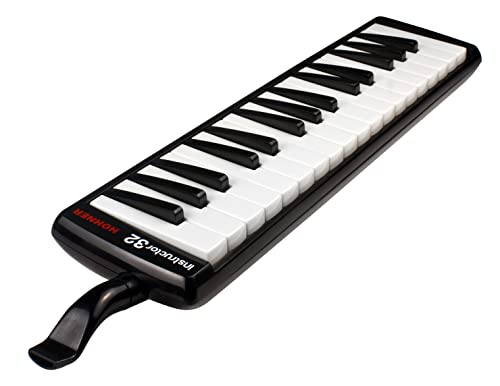
Hohner helped popularize the melodica, and the 32B Instructor model, also sold as the Student 32, is its classic school and beginner instrument. Its 32 piano-style keys run from F to C, covering about two and a half octaves. That is a sensible range for lessons, pop and rock parts, and first ensemble work, and the shorter keyboard keeps the instrument compact and easy for younger players to hold and carry.
The plastic body keeps weight down for classroom use. You get a short mouthpiece for playing held up to the mouth, plus a flexible extension tube for tabletop playing with two hands, and a case for transport between home, school, and rehearsal. For many students, that combination is exactly the right starting point.
Pick the Hohner 32B if you are buying for a student, a school program, or your own first melodica and you value straightforward, proven design over extra keys you may not use yet.
Specs
- Keys: 32 piano-style keys
- Range: F to C, about two and a half octaves
- Body material: Plastic
- Color: Black
- Included components: Case, short mouthpiece, and flexible extension tube
- Intended use: Student and instructor classroom playing
Suzuki M-37C Melodion

The Suzuki M-37C is the step-up instrument in this guide. Suzuki builds this alto Melodion in Japan with a metal cover and phosphor bronze reeds, a combination aimed at a clearer, more beautiful tone than basic plastic-cover models deliver. The reed and reed plate, the parts Suzuki calls the heart of the Melodion, are made in Japan, and the phosphor bronze reed material is chosen because it resists breaking and rust.
With 37 keys spanning f to f3, the M-37C covers a wider range than 27-key or 32-key educational models, suiting advancing students outgrowing a first instrument. Suzuki includes three mouthpieces: short, trumpet-style, and flexible, plus a light soft case. The short mouthpiece uses an O-ring to reduce air leaks, and the flexible hose has a ring structure designed to keep moisture from flowing into the body.
At 947 grams, it is heavier than the plastic student models here, the trade-off for the metal cover. Choose it if tone and long-term build are your priorities.
Specs
- Keys: 37 keys, alto range
- Range: f to f3
- Dimensions: 470 x 110 x 55 mm
- Weight: 947 g for the instrument
- Reeds: Phosphor bronze
- Cover: Metal, with aluminium listed among the materials
- Country of manufacture: Japan
- Included components: Short, trumpet-style, and flexible mouthpieces, plus a soft case
Eastar 37 Key Melodica

The Eastar 37 Key Melodica in black is a full-range option aimed at beginners and younger players who want 37 keys without stepping up to a premium instrument. Its 37 keys give you the same three-octave span as the other full-size picks here, so learners are not forced to transpose songs down to fit a shorter keyboard. Eastar describes the sound as pure and rich for an entry-level instrument, and the build uses ABS with copper components in the reed area.
The package includes a mouthpiece for direct playing, a carrying bag, and a shoulder strap, a ready-to-go kit that saves parents and teachers from hunting down a case separately.
Pick the Eastar if you want a complete, classroom-friendly 37-key starter package in black, especially for a beginner who will benefit from the extra range while learning.
Specs
- Keys: 37 keys
- Color: Black
- Body material: ABS, with copper components
- Included components: Mouthpiece, carrying bag, and shoulder strap
- Intended use: Beginner and student air piano keyboard playing
CAHAYA 37 Keys Melodica

The CAHAYA 37 Keys Melodica in blue rounds out this list with a colorful, accessory-rich alternative. Like the other full-size picks, it gives you 37 keys, so it handles school songs, pop melodies, and practice pieces without the compromises of a shorter keyboard. The body combines ABS and resin, materials chosen for a lightweight instrument that children and adults can hold for a full practice session.
CAHAYA sets this model apart with its double mouthpiece tube set. Two mouthpieces let you switch between direct and tube playing or keep a spare on hand. A carrying bag is included, and the blue finish is easy to spot in a classroom full of black cases.
Choose the CAHAYA if you want a 37-key melodica with a spare mouthpiece in the box and a finish that stands out.
Specs
- Keys: 37 keys
- Color: Blue
- Body material: ABS and resin
- Model: CML0049BL
- Set contents: Double mouthpiece tube set with two mouthpieces
- Included components: Carrying bag and case components
- Item weight: 1 kilogram as listed for the packaged product
How to Choose the Right Melodica
Start with key count. A 32-key melodica such as the Hohner above covers about two and a half octaves, which is plenty for lessons, simple songs, and group classes, and the smaller body suits younger players. A 37-key model adds roughly half an octave at both ends of the keyboard, giving you three full octaves. That extra range matters once you play real repertoire, accompany other instruments, or read sheet music written for piano. Most adults and advancing students are happier starting with 37 keys.
Next, look at reeds and covers. Phosphor bronze reeds, as in the Suzuki M-37C, are valued for durability and refined tone, and a metal cover can add clarity. Plastic student models are lighter and simpler to replace if a school instrument is lost, so match the build to the setting.
Airtightness matters more than many buyers expect. A leaking melodica forces you to blow harder and makes soft notes unstable. Rubber seals, O-rings, and well-fitted keys are worth weighing alongside key count.
Finally, check the mouthpieces and case. A short mouthpiece suits playing held up, while a flexible tube lets you lay it flat and play with both hands. A fitted case protects the keys and keeps mouthpieces from going missing. After each session, drain moisture and store it dry in its case.
Frequently Asked Questions
How many keys should a beginner choose?
Most beginners do well with either size. Choose 32 keys for a younger child or a school program where compact size and simplicity matter most. Choose 37 keys if the player is an older child, a teenager, or an adult, because the three-octave range will last longer as skills and repertoire grow.
Can you play a melodica with both hands?
Yes, when you use the flexible extension tube. Lay the instrument flat on a table, blow through the tube, and both hands are free for the keys. With the short mouthpiece, you normally hold the melodica with one hand and play the keys with the other.
How do you clean and maintain a melodica?
Empty moisture after every session, wipe the mouthpiece, and let the instrument air out before closing the case. Mouthpieces and tubes can be rinsed and dried fully before reuse. Store it in its case, away from heat.
Is a melodica good for learning piano basics?
It is a useful bridge. The piano-style keyboard teaches note layout, fingering, and reading music, while breath control adds expression a beginner keyboard cannot offer. It will not replace piano key weight or pedal technique, but builds fundamentals portably.
Conclusion
For most buyers, 37 keys is the sweet spot, and the Yamaha P-37D is the strongest all-around choice here for smooth key action, careful sealing, and even, factory-adjusted tone. Classroom students are well served by the Hohner 32B, while the Suzuki M-37C rewards players wanting metal-cover build and phosphor bronze reeds made in Japan. The Eastar pairs 37 keys with a bag and strap, and the CAHAYA adds a second mouthpiece and a bright blue finish. Match key count to the player, confirm the mouthpieces and case are in the box, and any of these five is ready to play anywhere.
More from Amazon
Programs that pair well with the guide above. Offers and eligibility are set by Amazon and may change.
Free shipping on eligible items, Prime Video and more. Eligible new members can start with a free trial.
Start a Prime free trialA Prime membership for ages 18-24 with a trial period. Eligibility is set by Amazon.
See Prime for Young AdultsAudiobooks and podcasts to listen to on the go. Eligible new members can start with a free trial.
Try Audible freeAd-free music streaming. Eligible new subscribers can start with a free trial.
Try Music Unlimited freeAs an Amazon Associate we earn from qualifying purchases.