Key takeaways
- Compare the best portable solar panels for camping and RV life, from a 45W travel panel to 200W folding models, with specs, connectors, and buying tips.
A portable solar panel turns any sunny campsite into a charging station. Paired with a portable power station, a folding panel can keep a camp fridge cold, refill phones and headlamps, run lights after dark, and stretch an RV battery through a long weekend without a generator. The catch is that panels vary enormously in size, weight, connector type, and how much power they actually deliver once the sun sits at an angle.
This guide compares five folding panels from five different brands, ranging from a pocket-sized 45-watt travel panel to full 200-watt models built for RV and basecamp use. Each pick below suits a different kind of trip, so start with how much power your gear really needs, then match the panel to your power station and the space in your vehicle.
Disclosure: As an Amazon Associate, I earn from qualifying purchases.
1. Renogy 200W Portable Solar Panel

The Renogy 200W Portable is the panel to shortlist first if you want one folding panel that covers most camping and RV jobs. It unfolds into four sections, stands on sturdy kickstand legs, and connects to most power stations and charge controllers through standard MC4 cables. Two USB-A ports and a USB-C port on the junction box let you charge a phone or headlamp directly from the panel while the main output feeds your battery.
In independent lab testing, this panel delivered close to its claimed output in strong sun, which is not something every folding panel manages. At under 15 pounds measured, it is light enough to move around a campsite chasing the sun, yet large enough to meaningfully refill a mid-size power station over an afternoon. The IP65 water resistance shrugs off splashes and light rain, though you should still bring it in during a downpour.
Specs
– Power: 200W monocrystalline
– Connectors: MC4 main output, 2 x USB-A, 1 x USB-C
– Weight: 14.8 lb
– Folded size: 23.7 x 23.0 x 2.0 in
– Water resistance: IP65
– ASIN: B0CNPHD4VY
Choose this one if you want the best balance of output, portability, and connector flexibility for car camping and RV travel.
2. Jackery SolarSaga 100W Solar Panel

The Jackery SolarSaga 100W is the natural partner for Jackery Explorer power stations, and a sensible pick for anyone who values easy setup over maximum wattage. It folds in half like a briefcase, has two built-in kickstands, and carries a handle on top, so moving it around camp takes seconds. The ETFE-laminated surface resists scratches and splashes, and the monocrystalline cells convert sunlight efficiently for a panel of this size.
Beyond the main cable for a power station, the SolarSaga 100 includes USB-A and USB-C outputs in a zippered pouch, which makes it handy for topping up phones and tablets directly at a picnic table. At a little over 9 pounds, it is easy to slide behind a car seat or into an RV storage bay. Owners of non-Jackery stations should check the connector and voltage before buying, since this panel is tuned for the Explorer lineup first.
Specs
– Power: 100W monocrystalline
– Cell efficiency: 23 percent
– Open circuit voltage: 21.6V
– Connectors: main DC output, 1 x USB-A (5V, 2.4A), 1 x USB-C (5V, 3A)
– Weight: 9.1 lb
– Folded size: 24.0 x 21.1 x 1.4 in
– ASIN: B07Q71LX84
Choose this one if you already own a Jackery power station or want a light, simple 100-watt panel for weekend trips.
3. Bluetti PV200 Solar Panel

The Bluetti PV200 is a 200-watt folding panel built around monocrystalline cells with an ETFE coating, a combination that holds up well to years of unfolding, packing, and travel. It uses standard MC4 connectors, so although it pairs naturally with Bluetti power stations such as the AC200 and EB series, it also works with many third-party stations and solar charge controllers.
The panel folds into a square package with a handle, and its adjustable kickstand legs snap into set positions, which helps you hold a good sun angle on uneven ground. A large storage pocket on the back keeps cables tidy in transit. Output in real-world testing lands below the biggest rivals here, but the build quality, long cable, and broad compatibility make it a dependable workhorse for RV owners who stay parked for several days at a time.
Specs
– Power: 200W monocrystalline
– Surface: ETFE coating
– Connectors: MC4
– Weight: 18.9 lb
– Folded size: 23.9 x 23.9 x 2.9 in
– Opened size: 82.5 x 23.6 in
– ASIN: B09B9RJLM7
Choose this one if you run a Bluetti power station or want a rugged 200-watt panel with standard connectors for mixed gear.
4. Goal Zero Boulder 200 Briefcase
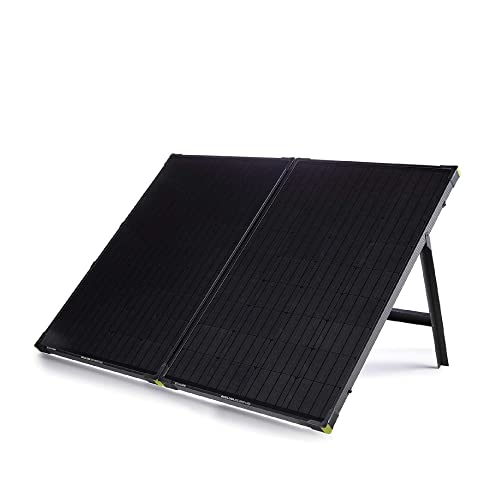
The Boulder 200 Briefcase takes a different approach from the fabric folders above. It is built from two rigid, tempered-glass panels in aluminum frames, hinged together like a suitcase with corner protection and latches that keep it shut in transit. That construction makes it far heavier than any other panel in this guide, but also far tougher: this is the panel to lean against a truck, leave set up at a basecamp, or mount semi-permanently on a work site.
Output is a full 200 watts through a High Power Port connector, and the Boulder 200 can be chained with additional Goal Zero panels when you need a bigger array. It is designed for the Goal Zero Yeti ecosystem, so check adapters carefully if your power station comes from another brand. Treat it as vehicle-based gear rather than anything you would carry far from the parking area.
Specs
– Power: 200W monocrystalline
– Construction: tempered glass with aluminum frame, hinged briefcase design
– Connector: High Power Port (HPP), chainable
– Weight: 43.3 lb
– Folded size: 40.0 x 26.8 x 3.5 in
– Opened size: 40.0 x 53.5 in
– ASIN: B0753TW31T
Choose this one if durability matters more than weight and your setup already revolves around Goal Zero Yeti power stations.
5. EcoFlow 45W Portable Solar Panel
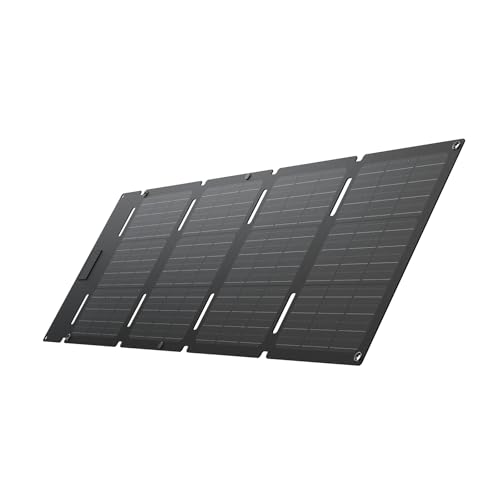
At the other end of the size range, the EcoFlow 45W is a folding travel panel for people who charge small devices rather than big batteries. It folds down to roughly the size of a hefty notebook, weighs a little over 3 pounds, and offers both USB-C and DC outputs, so it can feed a phone, a headlamp, or a small power station directly. The fabric exterior feels premium and stands up well to being tossed in a daypack or a camp bin.
Testers have noted that this panel performs especially well under cloudy skies and in morning or evening light, conditions where many small panels fade. You will not refill a large power station with 45 watts, and that is fine: this is the panel for backpackers moving between camps, bikepackers, and anyone who wants a backup charger that takes up almost no space in an emergency kit.
Specs
– Power: 45W monocrystalline
– Connectors: USB-C and DC output
– Weight: 3.2 lb
– Folded size: 9.0 x 12.2 x 1.6 in
– Opened size: 38.5 x 12.0 in
– ASIN: B0F43LRHV9
Choose this one if pack size and weight matter most and your charging needs stop at phones, lights, and small gadgets.
How to Choose a Portable Solar Panel
Match wattage to your battery. A rough rule is to pair at least 100 watts of panel with a 500Wh power station, and 200 watts with a 1000Wh station, if you want a realistic chance of refilling it in a day of good sun. Remember that real output usually runs below the number on the box, especially outside midday.
Check the connector first. MC4 is the most universal option and suits RV charge controllers. Brand panels from Jackery, EcoFlow, Bluetti, and Goal Zero may use proprietary plugs or voltages tuned to their own stations, so confirm compatibility or budget for the right adapter cable before you travel.
Decide how far you will carry it. Fabric folding panels in the 9 to 19 pound range move easily around a campsite. Rigid glass briefcase panels are far tougher but belong on vehicles. Small panels under 50 watts are the only ones that make sense in a backpack.
Look at water resistance and surface material. ETFE-coated panels resist scratches and handle splashes well. Check the IP code if you camp in wet climates, and never leave any folding panel out in heavy rain unless the maker explicitly allows it.
Think about setup. Kickstand legs, grommets for hanging, and a cable pocket all save time at camp. A panel that takes one minute to angle correctly will harvest more energy over a trip than a slightly stronger panel that stays flat in a bag.
FAQ
Can a portable solar panel charge an RV battery directly?
Panels with MC4 output can feed an RV battery through a solar charge controller, which most 200-watt folding panels assume you have or that your power station includes. Never connect a panel straight to a battery without a controller.
How much power will I actually get on a cloudy day?
Expect a steep drop. Good panels may deliver a quarter to a third of their clear-sky output under heavy cloud, which is why oversizing the panel slightly is a smart move for shoulder-season trips.
Can I connect two panels together?
Many 200-watt panels support chaining or parallel connection, but voltage limits on your power station decide what is safe. Check the input range in your station manual before combining panels.
Do I need a panel from the same brand as my power station?
Not always. Standard MC4 panels work across many brands, while proprietary connectors and unusual voltages are the usual blockers. Match the plug, voltage, and maximum input wattage and most combinations work fine.
Conclusion
For most campers and RV travelers, the Renogy 200W Portable hits the sweet spot of output, weight, and flexible connectors. Jackery owners should look at the SolarSaga 100W, Bluetti users get a rugged match in the PV200, and Goal Zero fans who prize toughness over portability have the Boulder 200 Briefcase. If your trips are measured in ounces rather than amp hours, the EcoFlow 45W covers small-device charging in a notebook-sized package. Pick the panel that matches your battery and your vehicle, angle it at the sun, and your camp power worries mostly disappear.
More from Amazon
Programs that pair well with the guide above. Offers and eligibility are set by Amazon and may change.
Free shipping on eligible items, Prime Video and more. Eligible new members can start with a free trial.
Start a Prime free trialA Prime membership for ages 18-24 with a trial period. Eligibility is set by Amazon.
See Prime for Young AdultsAudiobooks and podcasts to listen to on the go. Eligible new members can start with a free trial.
Try Audible freeAd-free music streaming. Eligible new subscribers can start with a free trial.
Try Music Unlimited freeAs an Amazon Associate we earn from qualifying purchases.