
Key takeaways
- 10 to 12 inches: one to three people, side dishes and breakfasts.
- 12 to 14 inches: a family of four, typical weeknight meals.
- 15 to 16 inches or large rectangular: big families, entertaining, batch cooking.
For most households, a 12 to 16 inch electric skillet with a removable temperature probe, a tight-fitting lid and a nonstick or well-seasoned surface is the best all-round buy, with Presto, Cuisinart and Hamilton Beach among the best-known makers, while those who cook for crowds should look at deeper or larger models and those with small kitchens at compact 11 to 12 inch units. This guide explains what to compare, so you can match a skillet to your cooking style, storage space and budget tier.
Our top picks



As an Amazon Associate we earn from qualifying purchases at no extra cost to you.
At a Glance: Well-Known Electric Skillet Options
| Option | Best for | Key stated features | Limits |
|---|---|---|---|
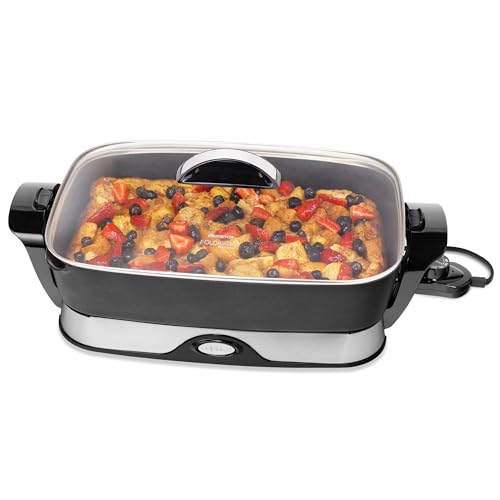
| Presto large electric foldaway skillet (about 16 inch) | Family meals, one-pan dinners, frying chicken | Maker lists a nonstick surface, helper handle and removable control master probe, and a fold-away design for storage | Large footprint; some versions are not dishwasher safe |
| Presto 11 to 12 inch models | Small households, dorms, camping with power | Compact size with a temperature probe | Limited capacity |
| Cuisinart 12 inch electric skillet | Everyday cooking with a more upscale look | Maker lists a nonstick surface, glass lid and adjustable temperature control | Mid-sized capacity; surface needs gentle care |
| Hamilton Beach rectangular or round electric skillets | Value-oriented cooking, breakfast for groups | Maker lists adjustable temperature, nonstick surface and lid | Quality varies by model |
| Oster DiamondForce-style electric skillets | Cooks who want a durable nonstick coating | Maker markets a reinforced nonstick surface | Coating claims are a maker statement |
| Zojirushi electric griddle-style cookers | Premium, precise tabletop cooking | Maker lists detailed temperature control | Higher cost and shallower cooking surface |
Product lines change and some models have been replaced or renamed. Use the maker’s page to confirm the current size, power rating, coating and warranty before buying.
Size and Capacity
Skillets are usually described by the diameter or by the footprint (for rectangular models). A rough guide:
- 10 to 12 inches: one to three people, side dishes and breakfasts.
- 12 to 14 inches: a family of four, typical weeknight meals.
- 15 to 16 inches or large rectangular: big families, entertaining, batch cooking.
Depth matters as well. Deeper skillets, sometimes 2.5 to 3 inches or more, can handle braising, soups, stews and deep-frying, while shallow ones suit pancakes and sautéing. A domed lid is useful for roasts, whole chicken pieces and large portions.
Temperature Control
Most electric skillets use a detachable probe, often called a heat control or master control, that plugs into the skillet and sets the temperature by dial. This has two benefits: the control can be removed for washing, and the skillet maintains a steadier temperature than many stovetop pans. Reviewers generally note that dial numbers are approximate, so an oven thermometer or a quick test with a known food helps you learn each unit’s behavior.
Look for a range that reaches at least around 400 degrees Fahrenheit, as stated by the maker, for searing and frying, and a low setting for simmering. Some premium units offer finer control and an indicator light.
Surface and Coating
- Nonstick coating: easy cleaning and low-oil cooking, but requires wooden or silicone utensils and gentle cleaning. Follow the maker’s care guide to protect the coating, and replace the skillet if the coating flakes.
- Cast aluminum body: common and heats quickly. Heavier cast bodies generally spread heat more evenly.
- Stainless or other finishes: found on some premium models, durable but food may stick without oil.
Lid, Handles and Feet
A clear lid with a steam vent lets you watch cooking without lifting. Cool-touch handles and knobs reduce burn risk, but surfaces and sides can still be hot. Check that the skillet has non-slip feet that keep it stable on the counter and that the handles are sturdy enough to carry a full pan. Deep skillets full of liquid are heavy, so use both hands.
Power, Cords and Electrical Safety
Electric skillets typically draw considerable power, often in the range of 1,000 to 1,500 watts according to many makers. Plug the skillet directly into a wall outlet if the manual advises it, and avoid sharing a circuit with other high-wattage appliances. Do not use damaged cords, and do not run cords across walkways or over a hot surface. Do not immerse the temperature probe or plug in water, and do not leave a heating skillet unattended with children or pets nearby. If an outlet feels hot, a breaker trips repeatedly or you notice damage, stop using the appliance and consult the maker or an electrician. Keep a safe distance between the skillet and walls or cabinets, because hot steam can damage surfaces.
Cleaning and Storage
- Remove the probe before washing the pan, and never submerge the probe or its connection.
- Let the skillet cool before washing. Use warm soapy water and a soft sponge for nonstick surfaces.
- Check whether the pan is dishwasher safe; many makers say hand washing extends coating life.
- Dry fully before storage. Some foldaway designs let you stand the skillet on its side in a cabinet.
What to Cook
An electric skillet is a good choice for fried chicken, pancakes, stir-fries, braised dishes, one-pan pasta, and keeping food warm at a gathering. Its portable design makes it useful for holiday meals, dorms, RV kitchens with suitable power, and small apartments with limited cooktop space. It does not replace an oven for baking, and it is not a pressure cooker or slow cooker, although some makers include recipes for stew and roast dishes.
Budget Tiers
Budget
Basic round or rectangular models from Presto, Hamilton Beach and others provide a nonstick surface, probe and lid. They suit occasional use and casual cooking. Expect simpler builds and a shorter coating lifespan.
Mid-range
Models from Cuisinart, Oster and higher-end Presto and Hamilton Beach lines offer heavier bodies, better lids and more reliable temperature control. This tier suits households that cook regularly.
Premium
Premium tabletop cookers, including Zojirushi-style units, provide finer control and refined build quality. Consider them if you plan frequent use and value precision.
Pick X If… Decision Table
| Pick this if you… | Choose |
|---|---|
| Cook for a family or hosting | A 14 to 16 inch deep skillet such as the large Presto foldaway style |
| Live in a small space | An 11 to 12 inch compact model |
| Want a glass lid and sleek look | A Cuisinart-style 12 inch skillet |
| Need good value for occasional use | A Hamilton Beach or basic Presto model |
| Want durable nonstick | An Oster DiamondForce-style option, following the care guide |
| Want precise control and premium finish | A premium tabletop cooker |
Alternatives
- Electric griddles: ideal for pancakes, bacon and sandwiches, with a flatter surface and no lid.
- Multi-cookers: offer slow cook, sauté and pressure functions in one pot.
- Stovetop skillets and Dutch ovens: better when you want searing power and oven-safe cooking.
Frequently Asked Questions
What size electric skillet should I buy?
Twelve inches fits most small to medium households, and 14 to 16 inches suits large families. Consider depth as well as diameter. Deep models handle stews and frying, while shallow ones are better for breakfast foods.
Is an electric skillet better than a regular frying pan?
It offers steady, adjustable heat and works anywhere with an outlet, but it takes counter space. A regular pan on a good burner can sear harder. Many cooks keep both for different jobs.
Can I wash an electric skillet in the dishwasher?
Only if the maker says so. Many skillets are hand-wash only, especially with nonstick surfaces. Always detach the temperature probe and never submerge it.
Can I deep-fry in an electric skillet?
Some makers show shallow or pan frying in their manuals, but deep-frying has fire and burn risks. Follow the manufacturer’s oil-level guidance, keep the skillet on a stable surface, and never leave hot oil unattended.
Why is my electric skillet not holding temperature?
Common causes include a loose probe connection, a worn probe, or a shared overloaded outlet. Check the manual and make sure the probe is fully seated. If the problem continues, contact the maker rather than attempting repairs.
How long does the nonstick coating last?
That depends on use and care. Avoid metal utensils, abrasive pads and overheating an empty pan. If the coating peels or flakes, stop using the skillet and replace it.





